Pages

Tuesday, 2 August 2011

Defenders of the Faith: Chaplains Part 3 - Contempory, Terminators & Conversions

This is a last round-up of the chaplains that I've managed to paint in the space of the past twelve months and have yet to allow onto the blog. This lot represents the odds and ends that don't really fit into a catagory of their own and as such are dealt with here in one final post of space marine zealotry.


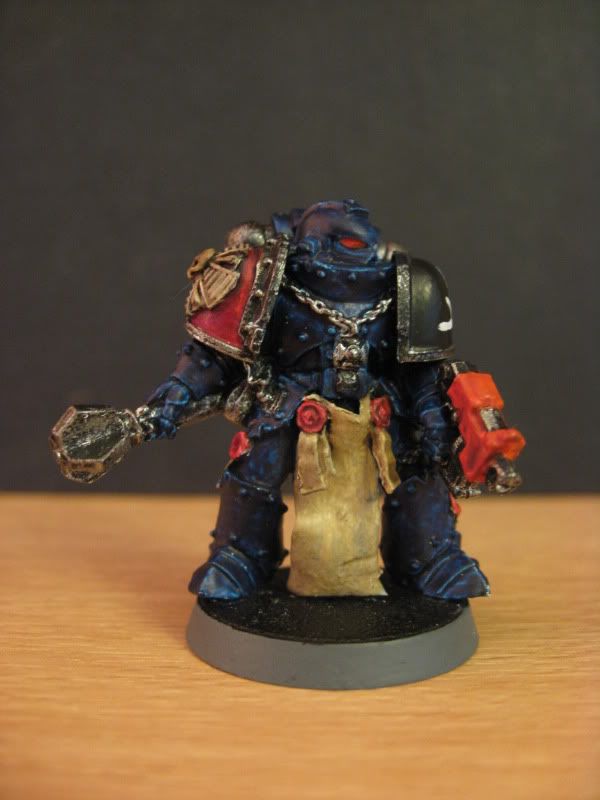
I've often been very hard on the current range of characters available for the space marines, but the chaplains for the most part seem to have escaped the crazy levels of mad poses and two tons of wargear. I had a blast painting this mini, the detail and pose are fantastic. But I still think that he's asking to be shot in the chest.
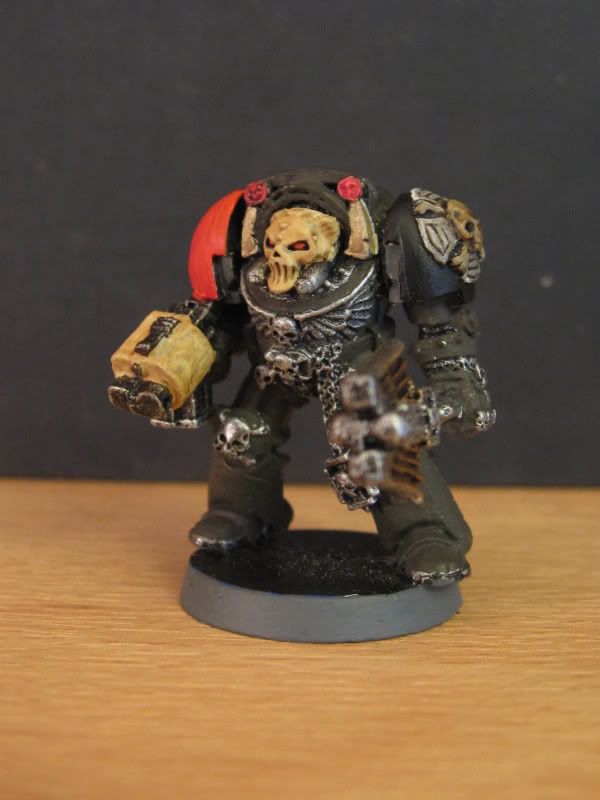

This guy is pretty much the epitome of what a terminator character looked like back before the introduction of the new wider bases. He also has a far more conservative pose than the later terminator chaplain and his wildly flailing chain of ammunition! I like the new bases and the emphasis that they lend to a terminator, but I still admire the fact that almost as much miniture was once packed onto a 25mm slotta base.
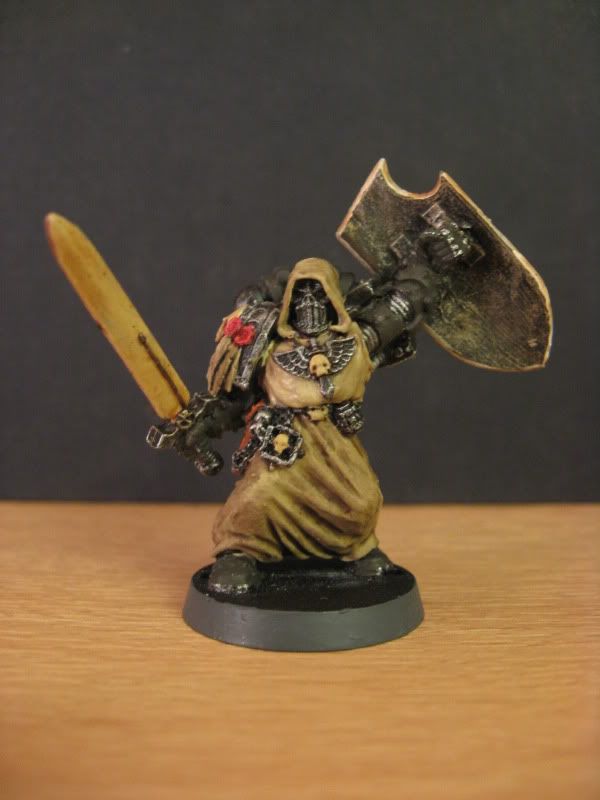

Converted from the Dark Angels Chaplain Asmodai, this model represents a chaplain of the Bladesworn company. I simply removed the crozius from his left hand and attached a shield from the Chaos Warriors box with the symbols removed by filing. Rather than keep to the bone colouring on the helmet, in this case I was sure it would be lost in the tones of the robes, I instead used it on the outer face of the shield and the blade of he powersword. All in all, I was very pleased with the way this one turned out.

This started out as Xavier of the Salamanders, a mini that I have no idea why I bought in the first place and spent a long time in the "to do" pile. Loosing the crazy lizardskin cloak and removing a few Salamander icons left a fairly generic chaplain, but not a bad one. I coloured the kneepads bone in order to draw attention away from the more subtle flame motifs on the legs and concentrate attention on the overall scheme.
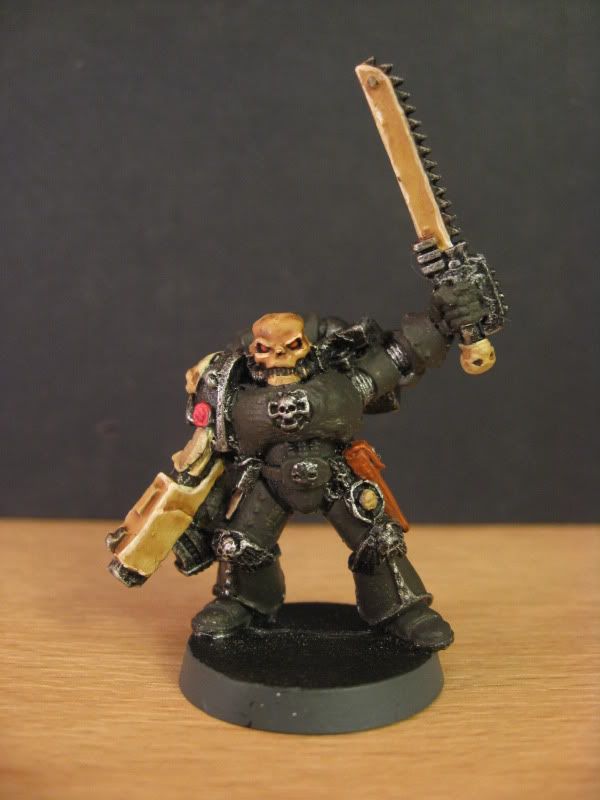

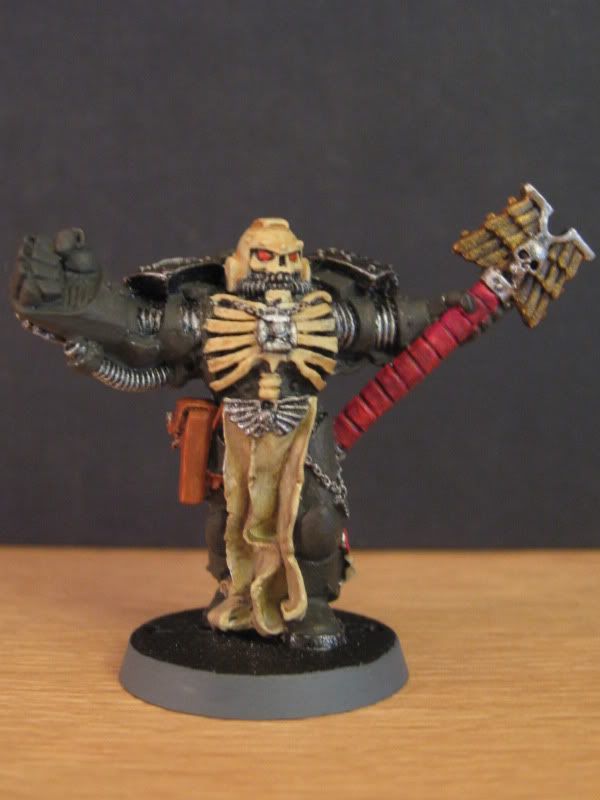
This Blood Angels Death Company chaplain lost his rather over the top headdress and the more crazy elements of the chapter iconography. I replaced his all too Blood Angels crozius with a chainsword and linked it to his bolter with the bone colourscheme. I covered the mad chestplate with greenstuff and mounted a terminator honour in the centre as well.


This is a true bits box chaplain if ever there was one, with legs and arms, head and chainsword from a chaos marine, torso from a plague marine, backpack from a legion of the damned mini and a groincloth to cover his shame at such a mixed heritage. Not the best chaplain in my collection, but I don't think it's bad for a mini put together from random parts.

This is another chaplain conversion that is more about experimenting than anything else, but does have the honour of being the first marine in my collection to be equipped with a jump-pack. The elements of the body are standard for an assault marine, but the head was a leftover from an old Chaos Warrior box with a hood sculpted from greenstuff.

Thursday, 30 June 2011

The Bladesworn: Part 1 - Company Champion & Honour Guard

It feels as though I've been away from this blog for years rather than seven months, but I'm going to try to get things started again by jumping straight into a new post. These are the first completed minis from one of the warrior brotherhoods that exist within the Sons of the Apocrypha: The Bladesworn.

Selected from the most skilled hand-to-hand combatants of the chapter, the Bladesworn are the elite shocktroops that attack with jump-packs or via teleporting into the very centre of the battle to deliver a decisive and vicious blow to the enemy. They are the hammer as opposed to the anvil formed by the second warrior brotherhood of the chapter known as the Hearthguard.


The company champion embodies the pride and fervour of the brotherhood and acts as a focal point for the marines deployed on the battlefield. Despite the status of the Bladesworn as the most able close combat battlebrothers in the chapter, the champion is often not the most elite of that elite and may more likely be chosen for his skills and qualities as a leader of men able to inspire the loyalty of his brethen. No champion of the Bladesworn was ever chosen for displaying the hallmarks of a bloodthirsty psychopath or cold-blooded killer.


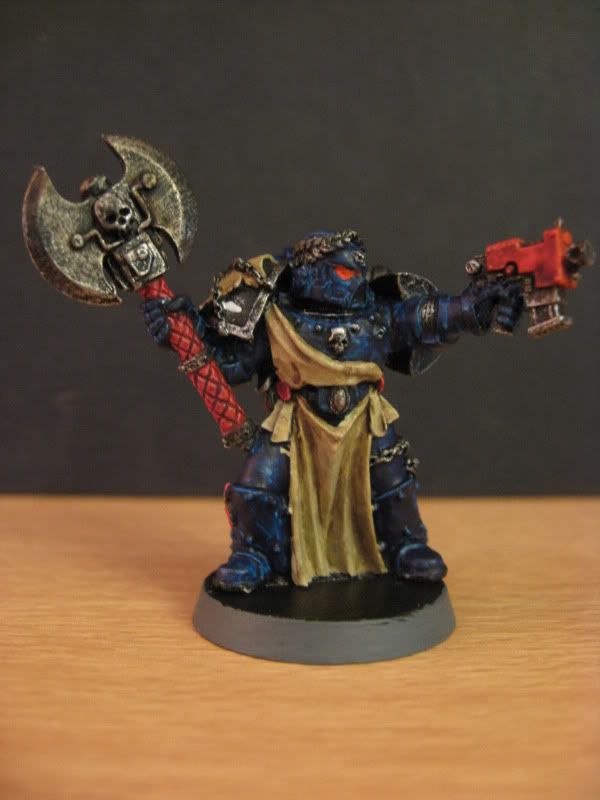
Bladesworn Honour Guard with Poweraxe & Boltpistol: chapter legend names the Bladesworn as the first of the warrior brotherhoods of Basilisk to swear fealty to the master of the chapter upon his blade. This gives them their name and grants them the honour of supplying the honour guard assigned to the master of the chapter above and before all others.


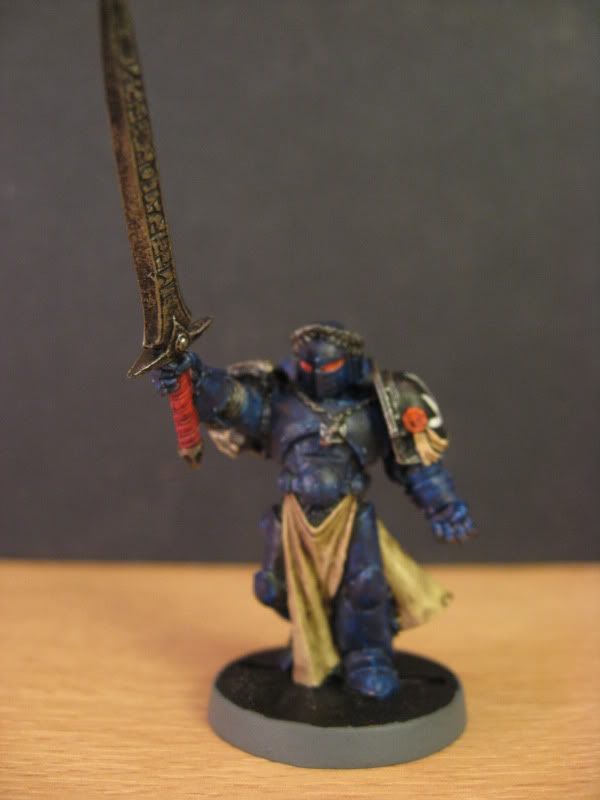
Bladesworn Honour Guard with Powersword & Boltpistol: the derivation of the deep blue colouring of the helmet, chestplate, groin, right arm and leg of the power armour worn by the chapter marines derives from the original heraldry of the Bladesworn. As a mark of special favour, the marines of the Bladesworn wear only that colour on their own power armour.


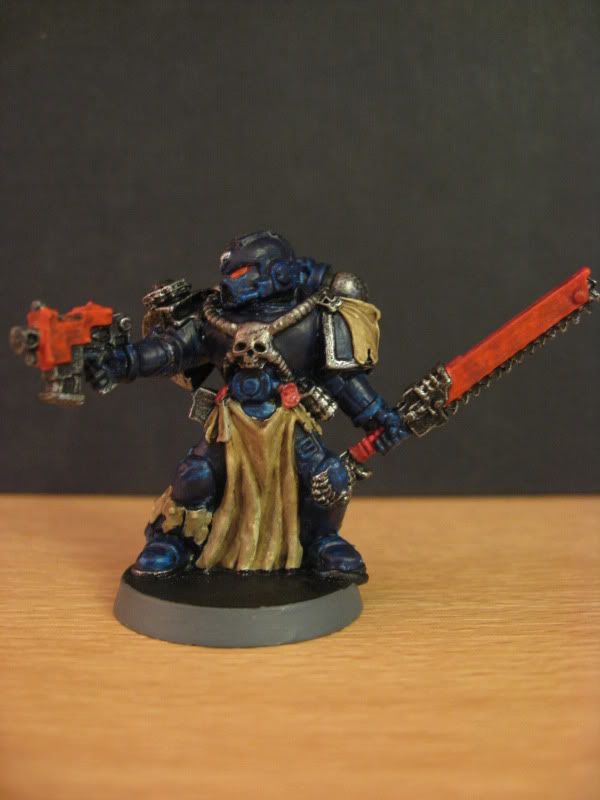
Bladesworn Honour Guard with Chainsword & Boltpistol: most of the brothers selected for membership of the Bladesworn are native to cultures where martial training is central to life and as a result there exists a shortage of members from worlds other than primitive and feudal in development. In practice this has led to the brotherhood becomming more and more entrenched in a philosophy influenced by rigid concepts of honour and obligation sometimes at odds with the duties required of a marine chapter.


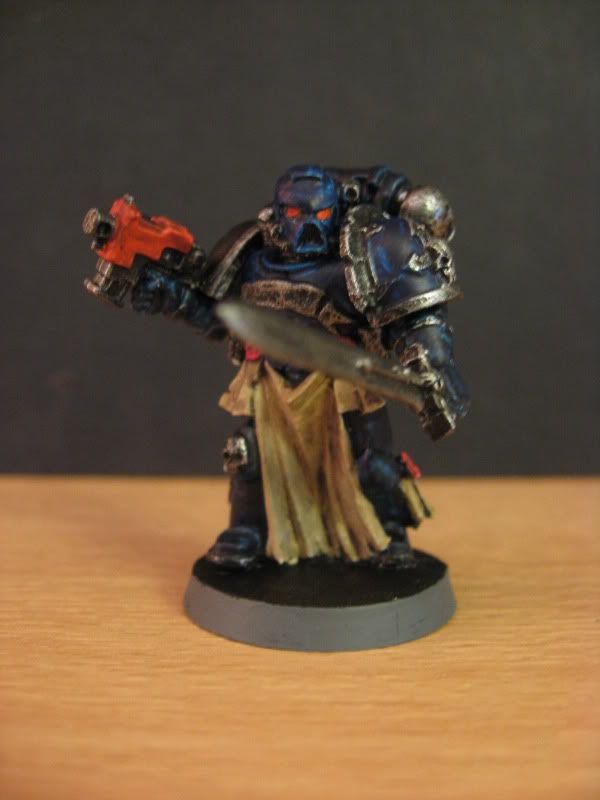
Bladesworn Honour Guard with Powermaul & Boltpistol: this is the only one of the minis in the group that needed any kind of modification and even then it was a simple matter of sculpting a groincloth from greenstuff in order to keep the unit constant. As far as I know this is the only non-chaplain marine ever modelled with a mace of any kind.

Thursday, 18 November 2010

Space Marine Armour Variants - Part 1: Mark IV


I love the history that has been built up over the years to name and explain the evolution of the power armour of the space marines and some of the best miniature sculpts that GW produced in the nineties were produced to illustrate this. Mark IV or Imperial Maximus Armour is one of the most interesting in my opinion due ti the fact that it was intended to be the culmination of the previous types and consolidate their strengths while also making up for their weaknesses. Stalled in production by the Horus Heresy and then hijacked by the traitor legions that overran Mars, the suit ssems to me to hint at the direction in which the Imperium was headed before it was doomed to superstitious stagnation after the Emperor's internment in the Golden Throne.


Although Forge World have recently started making components for some of the early armour variants, it might actually be cheaper to search out these original miniatures on Ebay and other second hand sources. This is due to the fact that they sell for typically sell for under fiver including P&P and the FW components are in excess of\twenty pounds and still require a tactical marine box set to assemble. In addition, these are discontinued miniatures and as such will only appreciate in value, adding to the value of any collection.

The Mark IV sculpts are fantastic miniatures that are a must for any marine collector and in addition represent an alternative type of power armour similar enough to later types to make the inclusion of even a single model in a unit a point of interst.

PS: You may have noticed that part one of this series focusses on Mark IV armour rather than Mark I. This has nothing to do with anything other than my own shambolic organisational skills. But here's a fun game - try to guess which armour type I'll be looking at next!

Space Crusade: Chaos Goes Clank - Part 2

Image property of Bordgamegeek.com used under fair usage rules

In the first part of this article I had a look at some of the marines and the weapons from the Space Crusade boardgame and in this part I want to take a moment to mull over the mechanical minions of chaos that populated the game. These were the biggest bad in the chaos player's arsenal in the form of the Dreadnought and the Androids.

The Dreadnoughts were so awesome and scary that they even got their own expansion: "Mission Dreadnought"...or "Missie Durfar" if you lived in the Netherlands and played "Starquest" (the Dutch version of the box seems to be the only one on the net!). The expansion allowed the chaos player to churn out dreadnoughts and androids faster than UK china factories are currently producing tat in anticipation of the upcomming royal wedding.


Now the original Dreadnought was a towering hulk of plastic that sported two heavy weapons and a pair of chained bolters, but then the expansion introduced this monster with a whole extra pair of weapon mounts. In response the marines had access to a tarantula weapon platform, but they must still have been filling their pants looking down the barrels of six weapons.


No amount of desperate rummaging has been able to turn up my own version of the impressive four-armed Dreadnought, so you'll have to make do with the standard version that I painted back when I was at uni in the late 90s.


At the time I painted this I was pulling together a selection of odds and sods to make an Imperial Guard penal legion squad and the Dreadnought got painted in their colour scheme. As far as I'm aware, this design for a dreadnought was only ever used in the Space Crusade game and bizarrely in the epic scale Space Marine game. No other GW dreadnought, chaos or otherwise, that I've seen has been but humanoid in design.


The Android fitted in somewhere as being more deadly than the Orc, but not as scary as the Chaos Space Marines in the game. To me they always seemed to be somewhat like the Fimir in the Hero Quest game, an odd addition to bolster the ranks. Perhaps they were so evil because they violated the taboo in the Imperium about AIs that imitated humanity?


It was only when I was stripping and repainting these miniatures for this article that it struck me they bore a striking resemblance to the Necrons in terms of their poses and design.


I wonder if someone went on a bit of a scavenger hunt when GW was looking for a new 40k race back in the late 90s?

I'll be trying to wrap things up in the last part of this article and have a look at the Chaos Marines, some more of the bad guys and some of the marines themselves.

Wednesday, 20 October 2010

Dark Heresy: Carbon Empire Conspiracy

Image property of Fantasy Flight Games and used under Fair Useage

It was about three years ago now that my old friend Lee presented me with a copy of Dark Heresy on my birthday and at the time my feelings about the game were mixed. As a GM, when a player gives you a rulebook the situation can sometimes feel like that of a cat owner who has been presented with a freshly killed rodent by his feline companion. You appreciate the thought behind the gift, but both the player and the cat are saying: "This is what I want!"

My initial scan of the book was mixed as I was impressed by the presentation and thrilled to have on paper rules for all of the 40K hardwear that GW have come up with over the years. But at the same time I was somewhat turned off by the premise of characters being acolytes of an inquisitor and disappointed not to see more rules for things like space marines, eldar and orcs.

Of course I was far more enthused with the idea after I read the Eisenhorn and Ravenor novels and insisted that my players read them as well before I would even contemplate sitting down to write anything for a campaign. In the end it was all down to Dan Abbnett and his magic words that made me do a complete 180 on the whole idea and so late last year whilst on a holiday around the islands off the coast of Scotland, I started to jot down ideas.

There were a number of things that I wanted to focus on in the game that I felt were important to make it different from the things that I had read and translate the feel of the Abbnett novels at the same time. The first was that I wanted the threat in the game to be something other than Chaos and daemons, a threat that was internal to the Imperium and far more sinister in nature. The second was that I wanted the Inquisitor to be a far more remote and indistinct figure than the central characters of Abbnett's novels.

I set the game in a region of space known as the Argolid Cluster, a dense region of stars that had been cut off from the rest of humanity more due to bureaucratic errors than wild warpstorms. In that time the worlds had made their own way and deviated from the Imperial way, a matter that was set to rights when a taskforce arrived to bring the region back into concordance. The effort to achieve that has been ongoing for more then 300 years and the acolytes step into the tale when some of the darkest secrets of what the region has been hiding are being revealed.

I intend to keep making the occasional post here on the progress and content of the game and see where it takes me.

Tuesday, 19 October 2010

Son of the Son of the Apocrypha


Things have been a bit hectic recently, not least of all due to the fact that my family has just epanded to welcome the birth of my first child and as anyone in the know will tell you, the little angels can be quite demanding as far as your time and energy are concerned!

I still have a fair few things that I'm working on when I have the chance, including the second part of my trip into the retro world of Space Crusade and some modern and RT era rhinos that are the first vehicles I've ever painted for a WH army.

I'm also addressing the issue of some of the duplicate miniatures that I have managed to amass by taking a new look at the first marine chapter that I drempt up in my youth: The Astral Paladins. In addition I have some RT era Eldar that I want to have a twiddle with as well.

Hope to have something to post soon.

Wednesday, 1 September 2010

Book Review: The Horus Heresy - Nemesis

Image property of Black Library and posted under Fair Usage

I looked back and realised with something of a shock the other day that the Horus Heresy series has now more a dozen titles to its name and the saga seems to be in no hurry to reach the duel between the Emperor and his errant son high above Terra. For me the series has been the usual mixed bag of fantastic highs and plodding lows I would expect from such a large undertaking by the Black Library and it's coterie of regulars. As usual Dan Abnett and Graham McNeill stand out head and shoulders above the rest, but some of the other titles in the series were worthy of praise in their own right as well. On the other hand titles such as Descent of Angels and Battle for the Abyss seemed like nothing more than throwaway titles to keep the series rolling along.

So where does Nemesis fall in that spread? Well, somewhere inbetween is the only answer that I can give to that one as it's as much a mixed bag as I just claimed the series was itself. My previous experience of James Swallow was the first omnibus of his pretty awful Blood Angels novels and that set me off worrying about Nemesis from the start. But after a few dozen pages I was pleasently suprised by the novel and found that the combination of the assembling of the Imperial team of assasins juxtaposed with the lawmen hunting their daemonic counterpart worked quite well.

Swallow appears able to give life far better to the human characters that he creates than the superhuman staples of the Heresy setting that I suppose he has no choice but to include in a title from this series. Here the characters of Malcador the Sigillite, Rogal Dorn, Constantin Valdor and others come across as little more than parts of the scenery that have lines in the script. But the assassins and the people they interact with are an interesting lot and more than make up for it.

The gathering of the assassins from across Terra introduces a disparate and interesting collection of killers and at the same time takes the reader to some nice locations on the homeworld. Each of the assassins has an interesting bundle of murderous personality and back story and the interaction between the supposedly professional killers is suitably catty and vindictive enough to add an air of reality to the whole thing.

Perhaps the one thing that lets the book down as a whole is the daemonic assassin known as "Spear" in whom Swallow creates something that comes close to the first "Mary Sue" characater to appear in the Heresy series. Staring out from a pretty tame few random kills, the complexity of these pretty much lost due to Swallow's inability to describe them, Spear soon becomes and all singing and all dancing killing machine that grows new powers and abilities as he needs them. By the end of the book the character is killing everything in his path and offs the assassins one by one in a way that makes his inevitable death seem very improbable.

All in all Nemesis is not the worst of the Heresy series, but not the best either.

Read as something to keep you going until Prospero Burns is released.


Blogger